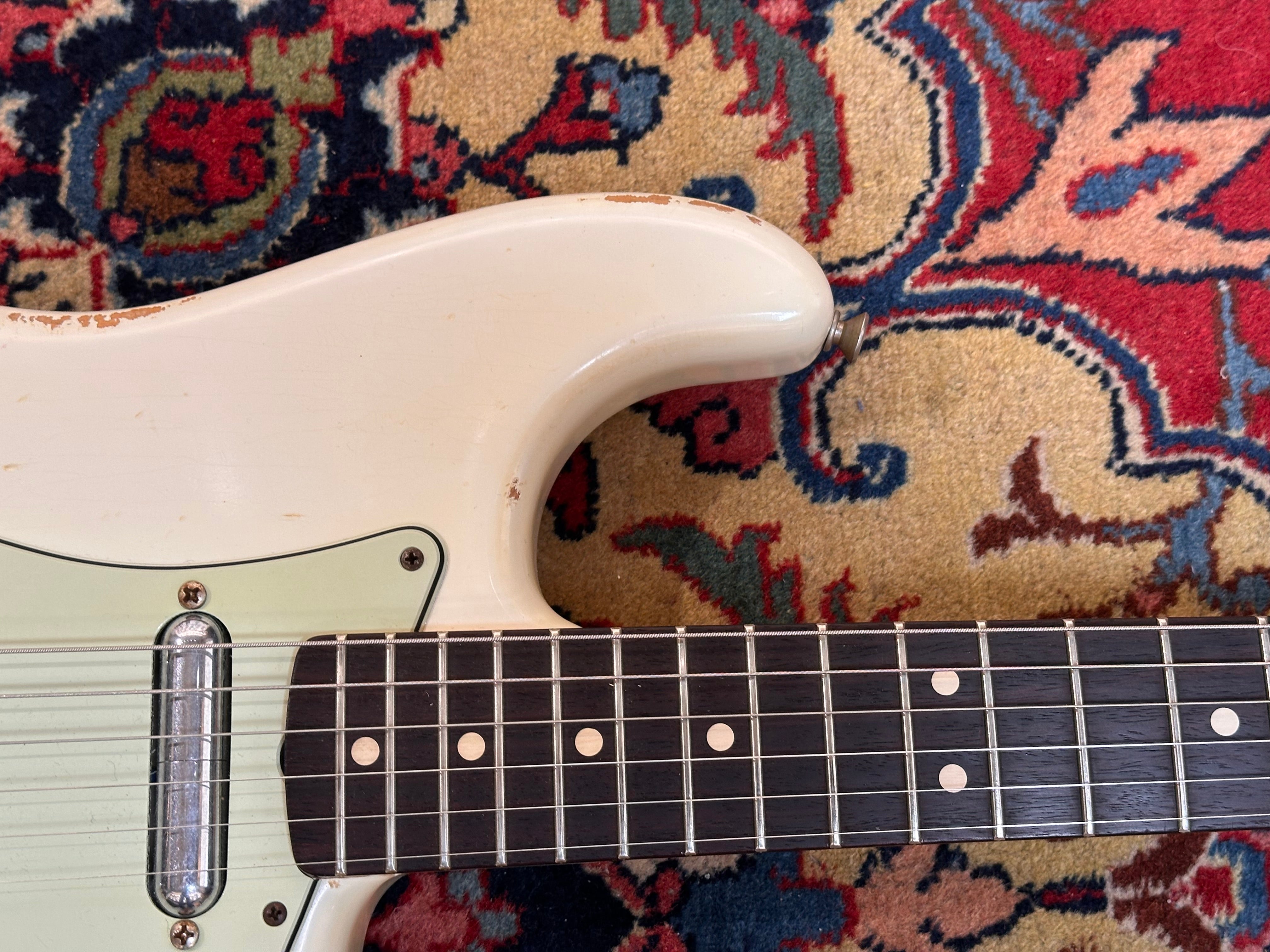

If you have ever stood in front of two Custom Shop Stratocasters wondering which one you will regret less in five years, this article is for you. We have been asked the same question in the showroom almost every week: what should I buy if I want my guitar to hold its value?
Until recently we answered that from experience. Now we can answer it from data.
Since April 2026 we have tracked every single Fender Custom Shop Stratocaster offered in Europe on Reverb. Every week, every guitar, every price. Here is what 632 guitars over 22 weeks told us.
The short version: buy used, buy something six to fifteen years old, and pay attention to the relic level. Buying new costs you around 20% of the value, roughly €1,100, and you never see it again. After year six the price stops moving, so what you pay is roughly what you get back. Relic level is the one specification that really moves the price. Colour and reissue year make no difference at all, so buy the one you actually like.

How we know this
Our Reverb Monitor logs the complete European Custom Shop offering every week: the asking price, the year, the colour, the relic level, the seller's country, and the date each listing appears and disappears.
- 632 Custom Shop Stratocasters tracked between 6 April and 24 August 2026
- 22 weekly measurements, more than 6,400 price observations
- 291 guitars were actively for sale on 24 August 2026
- 204 of those are team built with a traceable year, and form the basis of this analysis
For new prices we did a second count: 250 new Custom Shop Stratocasters at four Dutch dealers, typically €5,399 including VAT. For the history of new prices we went through Fender price sheets and dealer archives going back to 2015.
Masterbuilt instruments are left out of everything below. They are a market of their own with their own logic, and mixing them in would distort every number on this page.
New Custom Shop prices keep climbing
Before we look at used guitars, it helps to know what is happening at the other end.
In 2015 a new Custom Shop Strat sat around $3,900. In 2016 the range ran from $3,950 to $4,150. By 2022 the same kind of guitar cost between $4,700 and $5,950, and today the range runs from $3,850 for the plainest Relic to $5,500 for a Heavy Relic.
Two things stand out. The sharpest jump happened in 2021 and 2022, when Fender pushed prices up across the board. And in 2025 Fender added another 5% to the entire range because of import tariffs.
There is one catch worth knowing about. Before 2014 Fender published list prices that almost nobody actually paid, and in that year they switched to publishing real shop prices instead. Comparing a 2004 number with a 2026 number is therefore comparing two different things, which is why we start this chart in 2015.
The takeaway for a buyer is simple: the thing you are being compared against is getting more expensive every year. That works in favour of every used guitar on the market, including the one you are about to buy.
What does a used one cost, and how fast does it drop?
| Age | Guitars | Typical asking price | Share of new price |
|---|---|---|---|
| 0 to 2 years | 11 | € 4,690 | 87% |
| 3 to 5 years | 43 | € 4,325 | 80% |
| 6 to 10 years | 43 | € 4,379 | 81% |
| 11 to 15 years | 28 | € 4,394 | 81% |
| 16 to 20 years | 30 | € 3,895 | 72% |
| 21 to 25 years | 28 | € 3,762 | 70% |
| 26 years and older | 21 | € 4,230 | 78% |
From €5,399 new to €4,325 after three to five years. That is €1,074, or 20%, and it happens once. After that it stops: guitars aged 3 to 5, 6 to 10 and 11 to 15 years sit at €4,325, €4,379 and €4,394. Those three groups are, for practical purposes, priced the same.
That single fact is the whole argument for buying used. The first owner pays the only real depreciation this instrument ever suffers. Everyone after that steps onto a flat road. Same workshop, same builders, same guitar.
Buying new still makes sense if you want a specific model that never turns up second hand, or if you are ordering your own spec. But then you are buying an instrument, not value.
So should you buy the oldest one you can find?
No, and this is where most buyers go wrong.
Look at the table again and the obvious move seems to be a 21 to 25 year old guitar at €3,762. But that number is misleading, because older Custom Shops are different guitars.
Among 6 to 10 year old guitars, 77% are relic models. Among 21 to 25 year old guitars, only 18% are, and there is a lot of NOS in there instead. NOS is the plainest and cheapest finish level. So you are not comparing young against old, you are comparing relic against NOS.
Line them up properly and the effect nearly vanishes:
| Age | Relic family | NOS |
|---|---|---|
| 0 to 5 years | € 4,374 | € 4,350 |
| 6 to 15 years | € 4,417 | € 3,700 |
| 16 to 25 years | € 4,200 | € 3,696 |
| 26 years and older | € 5,299 | € 3,800 |
- Within the Relic family, ten extra years of age saves you €217. That is 5%, and it is too small to build a decision on.
- Within NOS it saves you nothing. €3,700 at 6 to 15 years, €3,696 at 16 to 25 years.
- Past 26 years it reverses. Relic models from the earliest Custom Shop years sit at €5,299, more than anything younger. More on that in a moment.
The discount for extra age runs out somewhere around year six. Whatever you save after that, you are saving on the specification, not on the age.
There are two more reasons not to go older than you need to. Older guitars sell more slowly: 56% of the 6 to 15 year old guitars left the market during our 22 weeks, typically within 35 days, against 44% of the 16 to 25 year olds, whose leftovers had been sitting online for 251 days. And prices spread further apart the older you go:
| Age | Cheaper quarter | Pricier quarter | Gap |
|---|---|---|---|
| 3 to 5 years | € 4,170 | € 4,594 | 10% |
| 6 to 10 years | € 3,900 | € 4,800 | 23% |
| 11 to 15 years | € 3,773 | € 4,737 | 26% |
| 16 to 20 years | € 3,620 | € 4,489 | 24% |
| 21 to 25 years | € 3,275 | € 4,589 | 40% |
| 26 years and older | € 3,599 | € 5,299 | 47% |
A wider spread means two things at once: there are bargains, and there are people asking far too much. With a young Custom Shop you know within a few hundred euros what is fair. With a 22 year old guitar you have to judge for yourself whether that €4,589 is justified. Wear, neck repairs, replaced parts and non-original electronics push those prices apart, and that is exactly where the risk sits.
One exception at the other end: do not buy a guitar that is nought to two years old. Those sit at €4,690 and still have €365 to fall before they reach the flat stretch. Of all the used options, that is the only one with real depreciation still ahead of it.
Which relic level should you choose?
This is the specification that moves the price most, and the only one we could pin down with confidence.
Comparing guitars of the same age against each other, here is where each finish level lands:
| Relic level | Guitars | Compared to the average |
|---|---|---|
| Super Heavy Relic | 7 | 34% more |
| Heavy Relic | 25 | 7% more |
| Relic | 50 | 2% more |
| Closet Classic | 5 | the same |
| Journeyman Relic | 23 | 2% less |
| NOS | 29 | 4% less |
Nearly 40% between the top and the bottom. That is a real gap, and it is the one specification difference that holds up no matter how we slice the data.
For holding value, though, the more useful question is not what a relic level costs but how much of its new price it keeps. And there the picture flips:
| Finish level | New price | Used, 2021 or newer | Keeps |
|---|---|---|---|
| NOS | € 4,948 | € 4,350 | 88% |
| Journeyman Relic | € 5,154 | € 4,307 | 84% |
| Relic | € 5,444 | € 4,560 | 84% |
| Heavy Relic | € 6,499 | € 4,499 | 69% |
Heavy Relic is the most expensive new and holds the least. Fender charges a steep premium for the heaviest ageing, and the used market only pays part of it back. Which gives you two clean rules:
- Buying new and want to protect your money? NOS or Journeyman. They keep 84 to 88%.
- Buying used? Heavy Relic is the bargain. Somebody else already absorbed that loss, and you pick it up at 69% of new.
The Cunetto exception
There is one corner of the market where all of the above stops applying, and it explains the upturn at the right hand end of our first chart.
Between 1995 and 1999, Fender's first relic Stratocasters were not aged in Corona at all. They were finished by Vince Cunetto in Bolivar, Missouri. Those guitars are known as Cunetto relics, and the market treats them as a category of their own.
In our 22 weeks we saw eight of them. Every single one was priced well above the rest of the market: between €5,900 and €7,282, against roughly €4,300 for an ordinary used Custom Shop Strat. Six of the eight disappeared from the market during our measurement period.
So when you see the line in our first chart turn upward past 26 years, that is not old guitars magically becoming valuable again. That is the Cunetto years sitting in that group and pulling the whole bracket up.
If you are shopping for value, treat the 1995 to 1999 relics as a separate market with separate prices, and do not expect an ordinary 1997 Custom Shop to behave the same way. We wrote about this era in more detail in The Cunetto Era: The Secret History Behind Fender's First Relic Stratocasters.
And here is what makes no difference at all: colour and reissue year
This is the result that surprised us most.
We compared guitars that were otherwise alike, same age bracket and same relic level, and then looked at what colour did to the price. Then we did the same for the reissue year, the '56, '59, '60, '62 and so on.
Neither one moves the price. The gaps we found between colours are no bigger than the gaps you get by chance when you divide a few hundred guitars into eleven groups. Same story for reissue year across ten different years. Relic level, tested exactly the same way, does stand out clearly. Colour and reissue year do not.
Here are the colour figures anyway, because people always want to see them:
| Colour | Guitars | Compared to the average |
|---|---|---|
| 3-Color Sunburst | 15 | 10% more |
| Candy Apple Red | 6 | 9% more |
| Olympic White | 13 | 5% more |
| Vintage White | 6 | 3% more |
| Sunburst | 22 | the same |
| Blonde | 10 | the same |
| Sonic Blue | 12 | the same |
| Daphne Blue | 6 | the same |
| Fiesta Red | 6 | 2% less |
| Black | 25 | 3% less |
| 2-Color Sunburst | 6 | 15% less |
3-Color Sunburst and Candy Apple Red sit slightly above, 2-Color Sunburst below. But the price spread within any one of these colours is bigger than the gap between them, and the pattern is exactly what random variation produces at these numbers. We would not pay a premium for it, and we would not base a purchase on it.
Reissue year tells the same story. The '62 sits a few percent above, the '54 and '55 a few percent below, and everything in between is flat.
So buy the colour and the reissue year you actually want. That is not a soft answer, that is what the numbers say. You do not pay extra for it and you do not get extra back for it. Of all the choices you make on a Custom Shop, this is the one you get to make purely on taste.
One honest caveat: colour may well affect how quickly a guitar sells, even when the price is the same. We do not have enough sold guitars per colour yet to say. That is on our list.
So what drives the value?
- Relic level creates nearly a 40% spread, and decides how much of the new price you keep.
- New or used costs you 20%, once.
- Age matters until around year six, and then stops mattering.
- Colour and reissue year do nothing at all.
Which makes the recipe short: buy used, buy six to fifteen years old, choose your relic level deliberately, and choose your colour with your eyes.
Should you buy new or used?
Buy used, unless one of these applies to you:
- You want a model that simply never appears second hand
- You are ordering your own spec and the build itself is the point
- You want the guarantee of an instrument nobody else has touched, and you are willing to pay around €1,100 for that
For everyone else, a three to fifteen year old Custom Shop gives you the same guitar from the same workshop, at 80% of the price, on a stretch of the curve where it stops losing money. With new prices climbing every year, that gap is only widening.
What we cannot tell you yet
We would rather say this out loud than pretend our numbers are bigger than they are.
- These are asking prices, not sold prices. Real transaction prices are usually lower. The comparisons between groups hold up, the absolute level sits a bit high.
- Some groups are small. The Cunetto figures rest on eight guitars, the Super Heavy Relic figure on seven, the nearly new group on eleven. Read those as direction, not gospel.
- "We found no effect" is not the same as "there is definitely no effect". With 127 guitars across eleven colours, a small effect of a few percent could hide from us. What we can say is that if colour does anything, it is too small to shop on.
- We correct for age, relic level and team built, but not for condition, originality, neck profile or pickups. Part of the spread in older guitars comes from exactly those things.
- This is the European market. The US market has different prices and different import costs.
We will update this article in about six months. By then the monitor will have run for a full year, which gives us roughly twice the data, enough sold guitars to say something about which colours sell fastest, and a clean run of prices in a single currency so we can finally measure how much sellers actually drop their price before a guitar sells. If you want the updated numbers, bookmark this page.
Frequently asked questions
Should you buy a Fender Custom Shop new or used? Used. A Custom Shop Stratocaster loses around 20% of its value in the first three years, roughly €1,100, and almost nothing after that. Buying used skips that one-time drop and gets you the same instrument.
Which year Fender Custom Shop Stratocaster should you buy? Six to fifteen years old, roughly 2011 to 2020. Biggest selection, most relic models, fastest turnover, and the price is flat there. Going older saves you only about 5% within the same relic level.
Is an older Custom Shop cheaper? On paper yes, in practice barely. The older offering contains far more NOS models, which is the cheapest finish level. Compare relic against relic and a 16 to 25 year old guitar costs €4,200 against €4,417 for a 6 to 15 year old.
What does a used Fender Custom Shop Stratocaster cost? On the European market in August 2026, typically €4,292 for a team built example, with most guitars falling between €3,787 and €4,723.
Does colour affect the value of a Fender Custom Shop? No. Across eleven colours and 127 guitars we found no price effect at all. Buy the colour you like.
Does the reissue year matter, a '62 against a '56? No. Across ten reissue years we found no price effect. Choose on neck profile, pickups and feel, not on expected value.
Which relic level holds its value best? NOS and Journeyman Relic, keeping 84 to 88% of the new price. Heavy Relic keeps the least at 69%, because Fender charges a steep premium new that the used market only partly pays back. If you want a Heavy Relic, buy it used.
Are Cunetto relics worth more? Yes, and by a wide margin. The eight Cunetto relics we tracked were priced between €5,900 and €7,282, against roughly €4,300 for an ordinary used Custom Shop Strat. They are a separate market.
Is a Fender Custom Shop a good investment? As an investment, no. As a purchase, yes. Buy used on the flat part of the curve and you lose little to nothing when you sell it on, which means playing it costs you almost nothing. Only the earliest years, particularly the Cunetto relics, show real appreciation.
Find your Custom Shop
At Never Enough Strats we specialise in used Fender Custom Shop Stratocasters and Telecasters, and we track this market every single week so we know what a guitar is really worth before we buy it or price it.
Browse the Custom Shop guitars we have in stock. →
Not sure whether a particular guitar, year or asking price is right? Contact us and we will look at it with you. No obligation, and we will tell you if we think you should pass.