
Two days ago, David Gilmour's Black Strat became the most expensive guitar ever sold at auction. $14.55 million. Let that sink in for a moment.
I run a shop that specializes exclusively in pre-owned Fender Custom Shop Stratocasters and Telecasters. I've bought and sold over 300 Strats in the past three years. So when a Stratocaster breaks world records and dominates every news feed on the planet, people ask me: what makes this particular guitar worth more than a giant house in Amsterdam?
Let me break it down.
A Replacement Guitar That Changed Music
Here's what most people don't know: the Black Strat was never meant to be special. Toward the end of Pink Floyd's third US tour in 1970, the truck containing all of their gear was stolen in New Orleans. David lost two Stratocasters: a white one with a rosewood board and a black one he'd bought just weeks earlier at Manny's Music in New York. The gear was eventually recovered, but the guitars were gone for good.
So David stopped back at Manny's on his way home to England and bought a replacement. Just six weeks after losing his first black Strat, he was back at the same shop buying another one. Under those inauspicious circumstances, the myth of the Black Strat began.
It was a fairly standard CBS-era 1969 Stratocaster. Alder body, originally finished in three-tone sunburst and then oversprayed in black at the factory. Maple cap fretboard glued to a maple neck, actually less common and less popular than the rosewood boards of that era. Serial number 266936, shipped from Fender in '69, assembled from parts manufactured in both '68 and '69, as was typical of Fender's production at the time.
Its first major performance was at the Bath Festival of Blues and Progressive Music in June 1970, in front of 150,000 people. The very next day, Floyd played the Kralingen Pop Festival in Rotterdam, just a few hours from where I'm writing this now. And then, in October 1971, came Live at Pompeii. The high quality of that footage, combined with the explosion of Dark Side of the Moon shortly after, would alone be enough to make the guitar a piece of rock history.
And then it played on Dark Side of the Moon. And Wish You Were Here. And Animals. And The Wall. That solo on Comfortably Numb? The Black Strat. Money? The Black Strat. Those four haunting notes at the beginning of Shine On You Crazy Diamond? As Gilmour himself puts it: they just fell out of that guitar one day.
A Guitar That Never Stopped Changing
Over the course of its life, the Black Strat was fitted with no fewer than six different necks, several different pickup sets, and a long list of other modifications. It wasn't even love at first sight, David experimented with other Strats early on. Steve Marriott from Humble Pie gave him one with a '59 sunburst body and a '63 rosewood neck. David liked the neck but not the body, so he swapped the necks between that guitar and the Black Strat. This kind of pragmatic, no-nonsense approach tells you everything about how Gilmour thinks about his instruments.
The modification history reads like a timeline of guitar technology. Copper foil shielding in the pickup cavities to fight noise from 70s effects rigs. A Gibson PAF humbucker briefly installed between the bridge and middle positions in 1973. A DiMarzio FS-1 bridge pickup during the Animals era. Then in late 1979, after The Wall was completed, Seymour Duncan sent a custom pickup that David preferred and it stayed in place until the guitar was sold.
A Charvel neck was ordered from Grover Jackson in 1978, with a heavier-than-standard truss rod. In 1983, a Kahler tremolo system was installed, requiring a section of the body to be routed out. According to Phil Taylor, Gilmour's longtime guitar tech, no consideration was given to whether this would affect the sound. It did. Taylor later said it seemed to deaden the sound, and the Black Strat fell out of favour when the new '57 reissue Strats came out.
A Lesson in Modifications (From a Dealer's Perspective)
 Now, here's where I have to put on my dealer hat for a moment, because this is something I talk to customers about almost every week.
Gilmour's approach to the Black Strat was that of a working musician who needed his instrument to do specific things. He routed, drilled, swapped, and modified without hesitation. And that was absolutely the right call for him. He wasn't thinking about resale value. He was thinking about the sound he needed on the next Pink Floyd album.
But if you own a Fender Custom Shop Stratocaster and you're thinking about doing the same: please think twice.
I see it regularly, someone brings in a beautiful Custom Shop Strat that's been modified. Extra holes drilled in the headstock for different tuners. Routing in the body for a different bridge or pickup configuration. A replaced nut, or a non-original pickguard with an extra switch hole. And every single one of those modifications chips away at the guitar's value. Significantly.
A fully original Fender Custom Shop Stratocaster with all its original parts, case candy, and paperwork will always sell faster and for more money than one that's been altered. That's not an opinion, that's what I see in my sales data across 300+ transactions. The difference can easily be €500 or more.
My advice? If you want to experiment (and I completely understand the urge) do it smart. Swap pickups, change the pickguard, try different electronics. But keep every original part. Put the original pickups in a labelled bag. Store the original pickguard. And whatever you do, don't drill new holes in the body or headstock. Those are permanent. You can always swap parts back, but you can't un-drill a hole.
If Gilmour's story teaches us anything, it's that a Stratocaster is a modular platform Leo Fender designed it that way in 1954. Four screws hold the neck on. The pickguard lifts off as one unit. You can experiment endlessly and return to stock. But only if you don't make irreversible changes.
The Black Strat sold for $14.5 million despite having been heavily modified, routed, refinished, and restored multiple times. But that's because David Gilmour played it on some of the best-selling albums of all time. Your Custom Shop '60s Relic in Shell Pink doesn't have that history, its value lies in its originality and condition. Protect that.
The Hard Rock Cafe Years and the Comeback
In 1986, the Black Strat was loaned to the Hard Rock Cafe for display, in exchange for a donation to charity. It would hang on the wall of one Hard Rock location or another for over a decade. When David finally asked for it back, the Hard Rock initially didn't seem to know it had been a loan, they thought they owned it. After the paperwork was sorted, the guitar was returned to England in poor condition, with damaged and missing parts, and without its original case. It had been displayed without glass protection at eye level above a table in Miami.
The guitar was restored: the Kahler removed, the routing filled in, the original Fender tremolo refitted, and a new '57 reissue neck installed. But David would rarely play it until 2005, when Pink Floyd reunited for Live 8.
And here's my favourite part of the whole story. During rehearsals, someone suggested David try the Black Strat for the old songs. Phil Taylor described the moment: David set down his red guitar with the EMGs, picked up the Black Strat, and his guitar sound instantly ascended to another level. His body language changed, becoming animated and interacting with the guitar as if he had just discovered an old, long-lost friend.
That's the thing about great guitars. There's something between a specific instrument and the person who plays it that you can't always explain with specs on paper.
The Custom Shop Signature Model
Having turned down Fender's requests for years, Gilmour finally agreed to a signature model in 2006. Mike Eldred, then head of the Custom Shop, and master builder Todd Krause flew to England to take measurements from the original guitar. After multiple prototypes and extensive pickup testing, the David Gilmour Signature Stratocaster was released in 2008 in two versions: a NOS model in black, and a Relic in black over three-colour sunburst, replicating the wear where the original sunburst shows through the chips.
The specs are meticulous. Select alder body with nitrocellulose lacquer. The neck profile is a precise duplicate of the 1983 '57 Reissue C-shape that sits on the Black Strat today. A Seymour Duncan SSL-5 in the bridge, a custom-wound single-coil in the middle, and a Custom Shop Fat '50s in the neck. And the signature mini-toggle switch that lets you add the neck pickup independently, giving access to that distinctive neck-plus-bridge combination that's a big part of Gilmour's clean tone.
An often-overlooked detail: the shortened tremolo arm. Standard trem arms are longer than what came on the original '60s bridges, and the Gilmour arms are shorter yet, designed to sit more comfortably in his picking hand. Small details, but they add up.
Gilmour himself has said he couldn't pick out his signature model from the original in a blindfold test. When the man who played the most famous Stratocaster in history says the Custom Shop replica does the job, that tells you something about the level of craftsmanship that goes into these instruments.
What This Sale Means for Stratocaster Lovers
The Black Strat's price is driven by cultural significance, not materials. You can't buy the sound of Comfortably Numb. That's a combination of the player, the moment, and decades of history.
But here's what the sale tells us about Stratocasters more broadly.
These instruments hold their value. The Stratocaster design is 72 years old. It has outlasted every trend, every competing design, every digital revolution. The guitars I sell from Fender's 1990s Cunetto era (the very first Custom Shop Relics) are worth more today than when they were new. Keep them original, and they'll only go up.
The design is timeless because it's modular. The Black Strat went through six necks, countless pickup swaps, a humbucker, a Kahler tremolo, and a full restoration and it still came back to life. Leo Fender's bolt-on, swap-anything architecture is what makes a Stratocaster a lifelong instrument.
Guitars are meant to be played. The Black Strat hung on a Hard Rock Cafe wall for a decade and came back damaged. Then it was put back in a player's hands, and the magic returned in an instant. Every guitar that comes through my shop gets a full setup by our luthier Gijs before it goes to a new owner. Play them. Just keep the original parts in the case.
Browse Our Collection
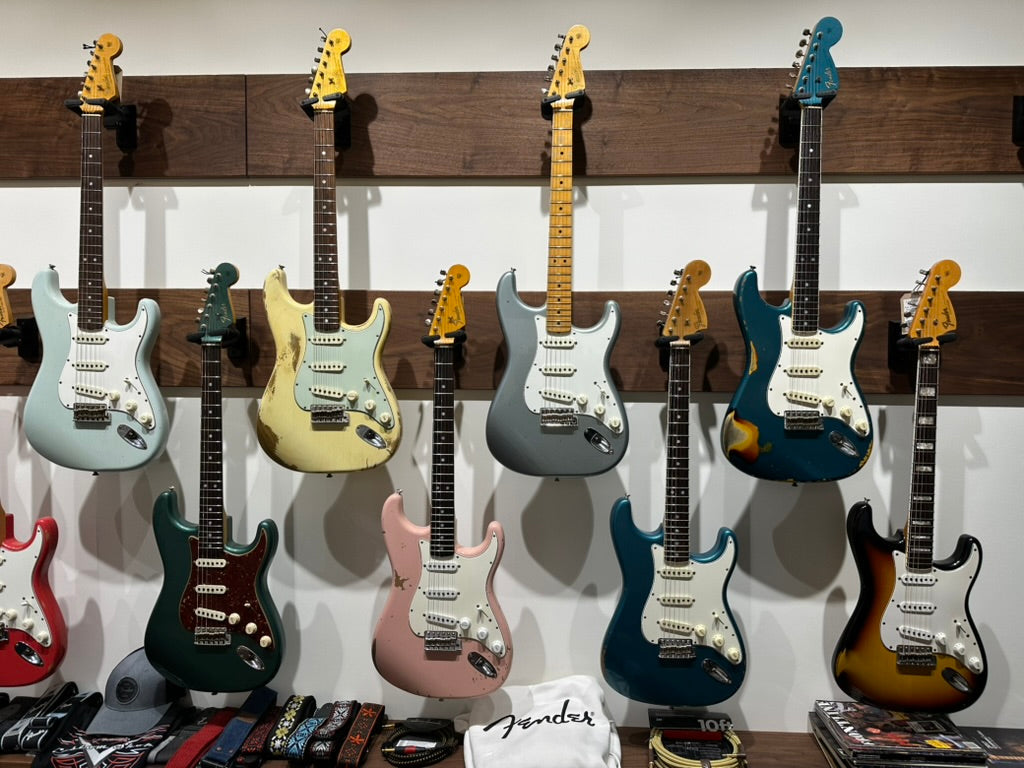
Inspired by the Black Strat story? We always have 40+ pre-owned Fender Custom Shop Stratocasters and Telecasters in stock, each one inspected and set up by our professional luthier. From early '90s Cunetto-era Relics to modern Journeyman and NOS models, in every colour from Sunburst to Shell Pink.
Every guitar ships fully insured across the EU, UK, and USA. And if you want to try before you buy, our showroom in Buren, The Netherlands, is open by appointment.
Browse Stratocasters | Browse Telecasters | Book a Showroom Visit
Glenn van der Burg is the founder of Never Enough Strats, a specialist dealer in pre-owned Fender Custom Shop Stratocasters and Telecasters based in the Netherlands. He has bought and sold over 300 guitars since 2022.
Sources and further reading:
- 5 Watt World — Short History of David Gilmour's Black Strat (Keith Williams)
- FuzzFaced.net — David Gilmour Signature Stratocaster specs
- Rolling Stone — Black Strat sells for $14.55M
- Phil Taylor — The Black Strat: A History of David Gilmour's Black Fender Stratocaster