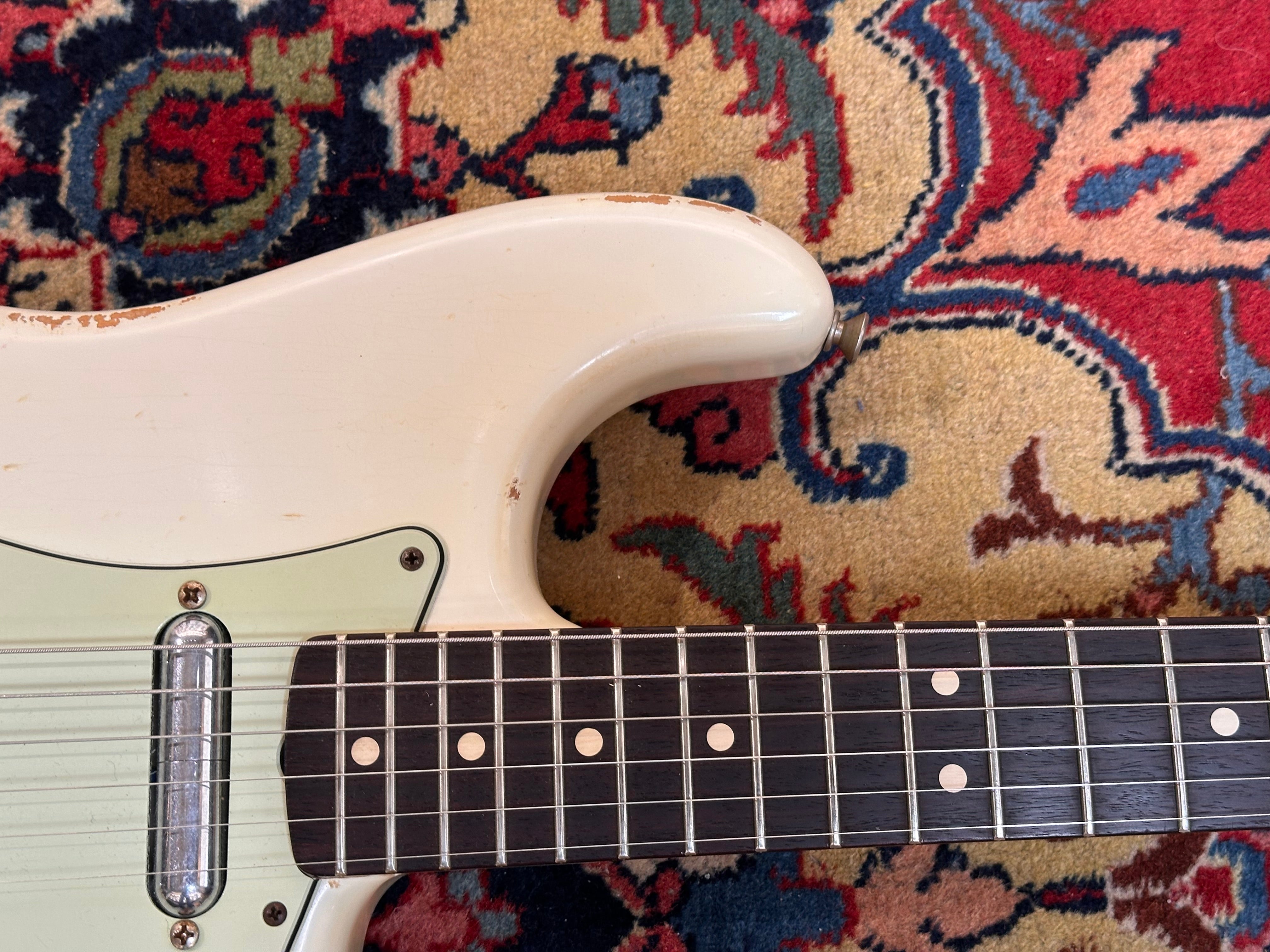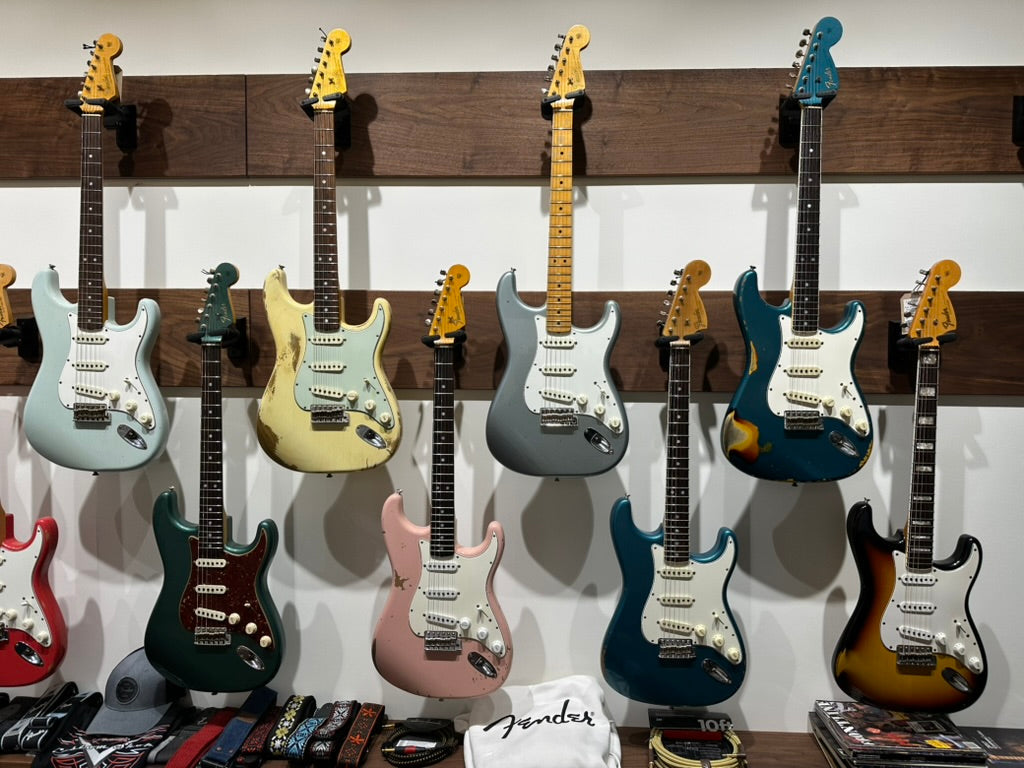

You know the Stratocaster. You know the Custom Shop. You may know John Suhr, Todd Krause, John Cruz, J.W. Black. Names that carry real weight in the world of high-end guitars. What most players do not know is that all of those names converge at a single point of origin. Not a brand, not a factory, not a decade. A person.
John Page started in 1978 as a neck buffer on the production floor of Fender's factory in Fullerton, California. Twenty years later, as Vice President and head of the Custom Shop, he left behind a transformed company, a generation of trained master builders, a new category of guitar, and instruments that collectors still actively hunt for today.
This is where it all started.
A plan that was ten years in the making
Page did not stumble into building the Custom Shop. He had been thinking about it for nearly a decade before it opened. Working in R&D alongside Freddie Tavares, the man who helped Leo Fender design the Stratocaster itself, Page became the youngest guitar designer in Fender history at 23. But by 1984 the ambition was already larger than his job title. He wrote a formal proposal for a separate Custom Shop: a small, elite unit that would build instruments for serious players and artists. CBS management, which still owned Fender at the time, rejected it.
"Back when I was in the model shop, we made custom guitars for artists all the time. Fender just didn't advertise it."
John Page
Two years later, after a brief departure to work on his music, he got the call. Dan Smith at Fender offered him a choice: return to R&D, or help launch the Custom Shop that new CEO Bill Schultz had finally decided to build after the CBS sale. Page chose the Shop. He brought with him everything he had learned from Tavares, from the Vintage Reissue project, from years of building instruments that the existing production line simply could not make.
15 May 1987: The Dream Factory opens
Two men. One narrow room they called the "bowling alley." A Haas CNC machine modified for woodwork. That was the Fender Custom Shop on the day it officially opened, 15 May 1987. Page and co-founder Michael Stevens were the entire operation.
Stevens built the first instrument: an Esquire for Elliot Easton of The Cars. But Page set the vision. He did not see the Shop as an expensive repair service or a vanity showroom for collectors. He saw it as the most important room in Fender: the place where everything the production line could not do would get done, where artists could have exactly what they needed, and where the company would prove what it was capable of at its very best.
The first Custom Shop instrument
Ordered: 27 February 1987
Shipped: 17 July 1987
Instrument: '57-style ash Stratocaster, blonde finish, bird's eye maple neck, serial number 0008
Client: Elliot Easton (The Cars), built by Michael Stevens
Within the first few years Page assembled a team that reads today like a hall of fame: Fred Stuart, Art Esparza, John English, J.W. Black, Larry Brooks, Jason Davis and Yasuhiko Iwanade. Later came Todd Krause, Mark Kendrick, John Cruz, John Suhr and Gene Baker. Most of those names went on to become defining figures in custom guitar building, founding their own companies, training craftspeople, shaping the field for decades after. Page selected them, gave them space, and built the culture they all worked inside.
On 13 September 1989 Page was formally given leadership over both the Custom Shop and Fender's entire R&D department. The man who buffed necks in 1978 was now Vice President, setting the technical direction of the whole company.
What guitarists actually say about this era
On the forums where players and collectors discuss these instruments, the John Page era comes up consistently. The tone is honest, sometimes divided on specifics, but a clear overall picture emerges: these are instruments with a recognised character of their own.
"Golden era for the Fender Custom Shop. Artists models, relics, time machines. The relics done by Vince Cunetto for Page are great examples of aging done right."
My Les Paul ForumPart of what players value is specific and practical. Page-era Custom Shop Stratocasters typically used a 9.5-inch fingerboard radius and taller frets, a more comfortable, playable setup than strict vintage reissues. Figured maple necks, often birdseye or flame, were common. These were instruments shaped by what actual players needed on stage and in the studio, not pure historical reconstructions.
"The Page era CS instruments had some notable features that made them different. They had flatter radius necks that made bending easier. They used highly figured wood for some necks... If you are a player who bends a lot and likes a low action, look for the Page-era instruments."
My Les Paul ForumCollectors also notice something specific: the Certificate of Authenticity. On every Custom Shop instrument from this period, the COA carries Page's signature. Buyers in the market for 1990s Custom Shop guitars specifically mention this. It has become its own mark of provenance.
"Especially with the John Page signature on the cert... this would have added some face value to these 90s era strats."
Strat-Talk ForumThe invention that changed everything
The most consequential decision Page ever made for the guitar world is also the one that carries the least of his name. In late 1994, master builder J.W. Black showed Page an aged Stratocaster that his friend Vince Cunetto had built: a guitar in gold metallic finish with every part weathered to the edge of convincing forgery. Page did not dismiss it. He gave Black and Cunetto permission to build two prototypes for the Winter NAMM show in January 1995. His instruction was direct.
"Don't tell anybody."
John Page, to Jay W. Black, late 1994
The two guitars went into glass display cases at NAMM as though they were authentic 1950s instruments. Nobody questioned it. When the truth came out, the response was immediate. Page described the moment: "Visitors would come along and say, 'Oh, that's really cool: you brought original ones as a tribute.' And we were saying, 'Er, yeah… how many do you want?' People went nuts. It was amazing."
Page had already solved the identity problem: steel stamps were made to press the word "Relic" directly into the wood of each body cavity, and the Custom Shop logo onto the back of every headstock. No confusion with genuine vintage originals. A new category of guitar was born, and it started here, with this decision, by this person.
The Cunetto years (1995–1999)
In 1995 the Custom Shop in Corona did not yet hold the permits needed to spray nitrocellulose lacquer, essential for convincing relic aging. Page outsourced the finishing work to Cunetto, who set up Cunetto Creative Resources Inc. in Bolivar, Missouri. Fender shipped him raw bodies, necks and hardware. Cunetto's team aged everything using techniques they never shared with anyone at Fender.
June 1995
First delivery: 20 Relic Nocasters from Cunetto's workshop to Corona. The Cunetto era begins under Page's direction.
1996
Cunetto expands to three times the original spray capacity. Forty sets of aged parts ship to Fender weekly. New finishes added, including Custom Colours mixed from original DuPont paint numbers.
1997–1998
The Relic line is a full production category in the Custom Shop catalogue. Page departs in 1998 after Fender moves the Shop into a space inside the main factory, a change he argued strongly against.
May 1999
Cunetto's final batch ships to Corona. Over 4,800 guitars produced in total. Fender takes relic production in-house. Cunetto's techniques go with him, never written down, never shared.
Cunetto never shared his methods. When Fender began doing relic work in-house after 1999 they had to start from scratch. The difference is visible to anyone who has handled both. Cunetto's work has a restraint and authenticity the first in-house relics lack; wear falls exactly where a real player's arm, thumb and palm would have met the instrument. Nothing is overdone.
"The relicing that Vince and his crew did in 1995–99 was far more tastefully done than some of the current CS ones that look like instruments that have been dragged behind a pickup truck on a gravel road."
TalkBass Forum, owner of a 1996 Cunetto '56 Mary Kaye Stratocaster and a 1997 Cunetto Jazz Bass"The models with his modifications from the second half of the 1990s are still the most treasured relic guitar pieces from the Fender Custom Shop."
Insounder.orgTime adds a further layer. A 1997 Cunetto relic left Cunetto's workshop already aged. It has now had nearly 30 additional years to continue aging on its own. The nitrocellulose finish has checked and yellowed further. The frets have worn in. The neck has developed a feel that cannot be replicated. The line between the artificial and the authentic has completely blurred.
What Page left behind
Page's departure in 1998 was quiet. Management and he had disagreed for years, and moving the Shop into the main factory was the final signal that the founding vision was no longer shared. He moved on to build a museum and an education programme for children, and eventually his own guitar line from a workshop in the Oregon forest.
But the people he trained did not disappear. John Suhr built one of the most respected independent guitar brands in the world. Todd Krause became the authority on David Gilmour-spec instruments. John Cruz produced some of the most sought-after artist models the Custom Shop ever made. The ecosystem of high-end American guitar building runs directly through the culture Page established in that bowling alley in 1987.
His successor Mike Eldred built a different but excellent tradition. The Time Machine series, the Masterbuilt programme: all serious craftsmanship. But the Page era is different in kind. It was the founding period. The people who built those instruments were figuring things out alongside Page, in an environment small enough that one person's vision shaped every instrument that left the room. That combination does not recur.
Guitars from the Page era at NES
When you find a guitar at Never Enough Strats with a build year between 1987 and 1998, you are looking at an instrument produced in the environment John Page created and ran. The Cunetto-era relics, built between 1995 and May 1999, are the most direct physical expression of that legacy. The COAs carry his signature. The "Relic" stamp in the body cavity was his idea. The arrangement with Cunetto was his decision. Because Cunetto's techniques were never transferred and Page's involvement ended in 1998, there will be no more.


"It started almost as a tongue-in-cheek thing, like worn-in Levi's or something."
John Page, on the origin of the relic guitar, Guitar World
What began as a half-secret experiment at a trade show in January 1995 became the defining aesthetic of the modern Custom Shop. The relic guitar, in all its current forms and price points and imitators, traces back to John Page saying yes to two prototypes and telling J.W. Black to keep quiet about it.
The Stratocaster started with Leo. The Custom Shop started with John Page.
Looking for a guitar from this era? We regularly handle Page-era and Cunetto-era Custom Shop Strats and Teles. Reach out directly, we're always happy to talk specs, history and availability.
💬 WhatsApp Glenn View Relic Collection